May 16th, 2025

#Science and #knowledge are key to the human species thriving, and as we all know, that’s #data.
On a lighter note, Stop Killing Games is an initiative in Europe that aims at forbidding publishers from pulling the plug on games that they are abandoning – and the petition now has over 1,000,000 signatures!
As a follow up to a recent post, the guys at GrapheneOS, an open source phone OS, are claiming that #iceblock are making false claims regarding #android vs #apple #privacy.
ICEBlock – Android Platform Statement
In certain countries, anonymity and #data protection can have serious repercussions – which #android doesn’t offer. This article tells us more about #Iceblock, currently the most popular app.
The internet of things (aka #IoT) is now commonly used in courts, and comes from any number of smart devices, as this article explains.
How Internet of Things devices affect your privacy – even when they’re not yours
Gemini AI Will Soon Access Calls and Messages on Your Android Even If You Turn It Off | Extremetech
So, in other words, using your #android phone is #unsafe #opsec as of july 7th 2025. #privacy #dataculture #news
#Tech is thirsty, and it plans on using a lot of #water. This article discusses the link between cooling fluids and #ai. The Overlooked Contributor to AI’s Climate Impact: Cooling Fluids
The markup gives us a howto as far as protecting your data from online trackers
A podcast about #dataculture? Why yes! The guys at internet archive are doing that!
Looking to see what media was a few decades ago? Here’s one way to do it!
Social media was amazing when it was allowing you to reconnect and share with a larger circle, but it has grown into something else, that this artist thinks may be a threat – so she made a video about it.
#canada may want to rethink how it manages its internet, according to this cbc article.
In this article, we find a more radical stance against #ai – have we gotten to unlearning?
The electronic frontier foundation has a very strong commitment to providing information about #dataculture.
Seen on the internet: “I want AI to do my dishes and mow the lawn so i can do art or enjoy it, not the other way around”. Artists around the world see the threat of generative AI, and are coming together to keep art human-centric. International Coalition Of Worker Unions Declares Emergency Over AI Use In Animation
People consume fast, and are looking at new ways to make better use of old devices. Old smartphones can have a new life as tiny data centers
We are entering an era of rapid change– what does that mean for #data, #security and our relationship to #tech?
In this article, the profitability of #AI is debated, as Microsoft reports losses on copilot subscriptions.
This is just one example of how being #safe on the internet may be tricky for some folks.
What is the cost of #trust when it comes to #ai?
In this article, we discover how hate groups are using #crypto to raise capital, and how that comes into play with American #politics.
Because we’re going through interesting times, Harvard is offering free courses about foundations of the American constitution !
Learn more here
In a world of data and algorithms providing immediate response to users prompts and actions, there’s a lot of good reasons to be conscious of what you are being exposed to. Heres an example why.
(MIT did the math) on AI’s energy footprint. Here’s the story you haven’t heard about #AI and the most significant online shift in over a decade
This article from the chicago sun is a prime example why #AI is a good thing, but may not be ready to replace #journalism
We’re entering a phase where #data is taking a whole new perspective– is it a good idea for #AI to be able to call emergency services and legal enforcement on its users?
For those looking to better understand how #ai interacts with #water: Sustaining AI’s Thirst for Water | Ecolab
There are a few interesting conversations to be had about this, notably in the comment section: Anthropic’s New AI Model Turns To Blackmail When Engineers Try To Take It Offline – Slashdot
US is choosing to cede leadership in #science and innovation. On purpose.
One of the serious issues with #cloud based #services is the notion that the price may change with no forewarning, or limits as to how and when this occurs.
Selling #data is the new side hustle of choice, as per Axios.
Relevance is growing, as the wall street journal reports on your personal #data winding up on the dark web
Minister of digital innovation, the Hon. Evan Solomon, that outlines how #canada might have a chance at succeeding by doing things its own way
An important decision regarding privacy
#law #data #tech
What if #data became synonymous with #history, or the very reality we’re operating in? What if it already was?
Data has real world value, ergo, is regulated, but what do we do when #tech doesnt want to play along with the #law?
This article goes in depth about a landmark decision in #Europe about the #legal uses of #Data.
Apple paying $95 million in a Siri eavesdropping settlement. Here’s how to file a claim.In the attention #economy, big tech companies have to answer their use of their products and devices, and this is exactly why #dataculture matters- it’s each of us against some quite hefty forces, and sometimes, you, the consumer, do have to #beware.
Data is important to understand culture. #Culture is important because it interfaces #data with #life as we know it – Which may include things like the four day work week, for example.
#socialmedia used to be a very central thing – now, #community might become a more relevant notions in months and years to come, because community is now more than ever, a choice.
Pope Leo XIV lays out vision for his papacy and identifies AI as a main challenge for humanity
Data privacy is important because of what algorythms can accomplish for a corporation, but how does that impact our society? Nations everywhere are starting to reign in the large tech players in. How far is it ok to let them go?
Grok is a fact loving AI, and some #maga people dont like it, according to this futurism article.
While #AI is in constant growth, the movement that refuses it is alive and well.
“I read a really great phrase recently that said something along the lines of ‘why would I bother to read something someone couldn’t be bothered to write’ and that is such a powerful statement and one that aligns absolutely with my views.”
A growing number of people and projects are looking into #privacy matters when it comes to #data, and one of those ways is to donate to the TOR project.
TOR is a simple way to protect your privacy and data, and they are currently fundraising to keep on growing their project.
Wow, it’s been a long, tough year already.
As we’ve just celebrated the new year, a lot has gone down.
The fires in Los Angeles are but one of the burning topics on the table, as just a few hours ago, an important felony conviction, the 34th, came down on the future american president elect. That would be big news on any day.
However, as of 48h ago or so, Meta announced it was removing any form of fact checking, triggering a massive exodus reaction, and for good cause, seeing as the social media giant, which includes Facebook and Instagram, has made drastic choices, and implemented them on a whim. Do we really need more disinformation?
Happy 2025!
’24 was well filled with surprises and the new year looks like it won’t be quiet – or at least, it started with a few bangs.
For example, the recent outrage regarding Meta’s AI profiles is an interesting conversation starter : Is it really a social media if some of the profiles aren’t actual people?
This second article from ArsTecnica asks interesting questions regarding privacy rights, notably stemming from consumer goods that are supposed to be owned by the consumer, but wind up essentially spying on their users… Who also happen to be their owners. Yes – These capabilities can become an asset in more extreme situations, but is that really a positive development for the consumer?
Bonne année 2025!
2024 était bien remplie, et sur le plan de l’information, ca s’annonce assez chargé pour 2025.
Par exemple, le tollé récent concernant les profils IA sur Meta posent une question intéressante: Est-ce encore un média social si une partie des utilisateurs sont faux, d’origine artificielle?
Ce second article d’ArsTecnica pose des questions intéressantes sur la question de la vie privée et de l’utilisation des données de vie privée que les géants de la tech collectent à travers des objets, qui sont sensés être la propriété privée de l’acheteur. Certes, ces capacités peuvent être un plus dans certaines situations extrêmes, mais est-ce vraiment une avancée pour le consommateur?
What is the internet?
Why, Mastodon user “Viss”, made this video about just that, and is glad you asked.
Comme une lettre à la poste – Like parcel through the mail
Sometimes, things change quickly.
Herebelow, a skewer of noteworthy articles, interesting for each their own reasons, when considering the avalanche of changes that have occured in the past few weeks – enjoy the read !
This article, an essay on America’s handling of it’s own healthcare system, is quite interesting, as it tells a tale of profit before humanism, on a level that is only occuring there. Food for thought, for americans and the rest of us.
Most recently, this article about the changes that the Harper government had made to the Scientific sector, which Poilièvre is likely to imitate, should he be put in power despite a security clearance.
Or, this Wired article about Data brokers, and the kind of data they make their business with, regarding targets that would be likely very sensitive.
And, from a little while back, this article shreds AI, calling it “money laundering for copyrighted data”.
Parfois, les choses changent rapidement.
Ci-bas, une enfilade d’articles que j’ai trouvé notoires, intéressant dans l’avalanche de changements que nous connaissons depuis quelques semaines – Bonne lecture !
Cet article, un essai détaillé sur l’anomalie que sont les USA quand il est question de soins de santé, démontre que ce pays est nettement plus aggressif que tous les autres sur le plan de la monétisation de la santé de ses citoyens. Oui, c’est une grosse lecture, mais savoir, c’est comprendre !
Plus récemment, cet article détaillant les changements qu’avait effectué Harper, que Poilièvre imiterait probablement, en cas où il serait élu même sans autorisation de sécurité.
Ou encore cet article de Wired qui explique au commun des mortels le niveau d’information disponible sur des cibles qui sont susceptible d’être sensible, via les revendeurs de data.
Et puis, il y a un certain moment, cet article, qui déchire l’IA en la traitant de “blanchiment d’argent pour la propriété intellectuelle”.
Mon pays, ce n’est pas un pays sans sa démocratie
Récemment, un flot alarmant de faux comptes publient des critiques incroyablement positives, et étrangement similaires, sur une visite de Pierre Poilièvre à Kirkland Lake. L’article du Devoir raconte certains détails des résultats d’une recherche sur la provnenance de ces messages… Mais est-ce que cette recherche suffit?
Nécéssairement, ces comptes et ces informations sont apparues de quelque part, par quelqu’un soit intéressé par l’idée de convaincre des gens, ou, comme l’article le dit, dans l’optique d’atteindre un résultat ultérieur.
Il est normal que nos lois soient à la remorque de faits, d’observations, de tendances, mais il faut, un moment donné, aussi poser les bonnes questions. Par exemple, la récente décision du gouvernement Biden, sur les taxes en lien avec les publications web et les grandes plateformes dans le contexte de l’Alena, sont juste des lettres à la poste, ou un signe que nos deux états pourraient mieux collaborer?
Tech over consciousness
This article from Techpolicy.press is incredibly engaging, and asks giant questions of immense relevence.
What is the role of tech in our society? Do we need socialized tech? What values are we reinforcing within our society with generative AI? Theses questions deserve answers. If you know the history of the automobile, we are witnessing a similarity of “accidental evolution”. The very same way we started with “it’s brand new, what could possibly go wrong?” and then found ways, we are adopting AI at an incredibly fast rate, even before it’s accurate enough, some would argue. And yet, Uk is introducing teacher-less classrooms – with at least the benefit of sparking the debate about this.
How much of this can we really tolerate, in today’s world?
And up, some more.
As the days are passing, I’m noticing even more interesting questions relating to the culture of data.
First up is this Mastodon post, where we see a screenshot of a Google search, post AI. I’ll shortcut to the obvious conclusion that nobody needs a search engine that comes up with falsehoods and re-writes history, and if you’re willing to argue that space exploration began in 1889 and that we were in mars before word war 1 started, please, feel free to do it elsewhere.
Regardless of how you cut this, it’s very hard to argue for system such as these to have access to massive scale biometric data, just yet.
This “new low in the ongoing erosion of fundamental rights” is exactly what we, at DataCulture.Online, are interested about. Tech is great. Humans are great. we just saw Terminator, and see why not every robot should be able to find Sarah Connor, and seeing how certain actors are always edging towards more power, it is reasonable to empower ourselves with the full capacity that the digital environment allows for, and channel it in the right direction.
The article, written in Germany, indicates that “every smartphone would become a potential state video surveillance system.”, and in the context of two provinces of that specific country’s recent elections, aren’t there a few opportunities for interesting conversations right there?
Vaya con dios, xitter
Unless you’ve been living under a rock, or maybe if you’ve just been living your normal life within the current state of disinformation and misinformation, you may have heard that Brazil is having a feud with Xitter (twitter), and that it is becoming a somewhat serious argument.
And then, it adds up.
As I keep developing this project, it’s interesting how articles, facts, topics and discussions relating to the topic are just lining up, and piling on.
This first thought experiment went drastically wrong (besides being in german – good thing we have tech!. Story goes something like this : Journalist fires up MS Copilot, asks him to dig into himself. The AI came out with a slew of insulting, criminal allegations and accusations towards the journalist, with the proper adress, family names, credentials, et al. The journalist files a report against MS for producing this data that’s highly corrosive, and dangerous for his personal future and safetuy… But the police turns down the request, because it’s not a person that created the data. What happens then?
This other article is in relation to a LA Times article makes an absolute echo to the preceding article, herebelow. The conversation about the cost to benefit analysis of AI remains to be truly understood.
The conversation is afoot
Every passing day, I’m seeing more articles that really speak to the nature of what we, at DataCulture.online, are trying to have.
Let’s start with this one article from Europe, we learn that there are initiatives to ensure that customers, who legitimitaly buy a videogame, are having to fight to garantee their right to enjoy this videogame, in the long term. Ok, it’s actually a petition, so that videogame publishers take some kind of steps to ensure that the videogame remains usable, in the long term, and may be rendered useless, at the will of the publisher, at any given time and for any given reason. But the bottom line remains: In the world of intangible, why are you paying tangible money for intangible products that you may be removed access to, without recourse? Sounds like something Mario and Luigi might save a princess for, maybe?
Moving on, here’s yet another example of what is afoot: There’s this (Paywalled…) article on Bloomberg about tech giants hiding the real carbon footprint of their operations, specifically what relates to AI. Now, while I encourage everyone to subscribe to every service and source of information, this particular image was shared, on social media, with this image, which is striking:
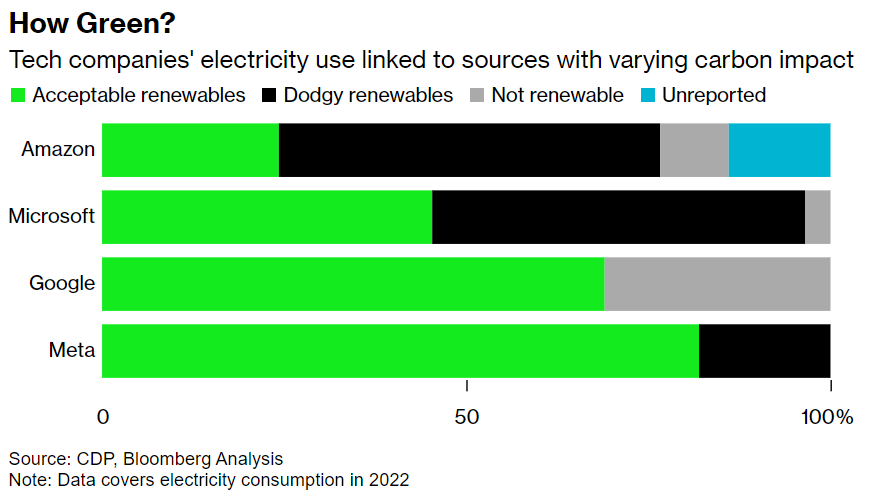
Now to me, those numbers speak masses, and spark a really interesting conversation with regards to climate change, and the real cost of our transition to big data.
Now keep in mind that this, in the context of energy scarcity, is a key strategic perspective, regardless of where you sit on the political spectrum. Indeed, if Data is bigger than oil, the conversation about both data and energy is quite a substantial one.
Speak of the devil…
As I’m scrolling through my morning feed, I stumble upon this fascinating article from The Conversation.
Wether we’re talking about Human Rights or intellectual property, there is a big conversation to be had about how tech is already meshing with the very fabric of our lives, and where what begins.
We expect the tech sector to keep striving for new innovation, but are we ready to have the conversations that surround these innovations?
While innovations like Neuralink and Emotiv headsets are amazing, and breakthroughs in both what they are and what they do, how comfortable will we really be when the sector has grown to 24 billion$, by the end of the decade?
As the very discussions about AI privacy and copyright issues are barely emerging, it is clear and obvious that this new #technology will change our relationship to privacy, and it’s garanteed to be a very gray area, with a nuanced learning curve and a myriad of consequences.
Seeing how big platforms have been behaving, can we trust this tech? How? With which legal tools, or civic protections for the user?
Key questions that go well beyond the notion, and use, of a “terms and conditions” form that nobody reads, quite probably.
On the shoulders of giants
Nothing gets built overnight or in a day.
If you are looking for a Canadian company that insists on datacenters that are sustainable from an ecological perspective, while guarantying it meets the best standards in the industry, just click here to use our referral code to this service.
Yes, we’re working on getting enterprise scale datacenters, and a slew of other innovations – But why argue with those who already have that?
Data is Everything.
As of 2017, according this article from The Economist, data is worth more than oil in the stock market.
This changes a number of things for you, as a consumer. No matter how you flip it, it’s quite certain that the dinosaurs and plant matter that died millions of years ago do not care what we do with their residual matter today, and if they did, they’d be having quite a problem manifesting, expressing their issues.
You, however, use a cellphone, a computer, a car, an internet connexion, a platform, a service, a credit card – and that data is what this new economy is made of.
Now, you’re not a cow. A cow, to the best of our knowledge, is generally happy given the right circumstances, to be taken care of in exchange for milk. Evolution put us on right under and over that cow, wether we’re drinking the milk, milking the cow, or driving the truck to the dairy plant. Basically, there’s a general agreement between cows and humans – treat us well, get milk, and couple further byproducts.
Now, this website is not about animal rights – this is about your rights, and our services, designed to help you protect those rights, that data, or make the best of it, in some way or another.
Thanks for stopping by, and stay tuned for the updates!